

What is chess?
Chess is a board game for two players, White and Black, who each command 16 men on a board of 64 squares. The aim of the game is to checkmate the opposing king.
Arguably the most popular of board games, gamerisms believes that chess games should also be categorized as strategy games.
Board skill games use a central tool to track a player's status and progress. All board games maintain turn-based play, in that one player's move or strategy is followed by the opponent's move or strategy. Players can only move at their turn.
This guide includes the chess pieces and their moves, the history of the game, rules and play, the chessboard position with a graphic, and the chess glossary from A to Z.
Chess pieces and how they move
Pick one of the chess pieces below to read more about it.
King
The king moves in a chess game to any square adjoining his own that is not occupied by a man of his own color. The king is banned from moving to a square where he is exposed to capture, and so cannot occupy any square next to the opposing king. In moving the king to a square occupied by a hostile man, the player captures that piece. In certain cases, the king and the rook, also called the castle, move at the same time. That move is called castling.
Queen
The queen may make any chess game move that a rook or bishop is able to make.
Rook
The rook moves from its square on to any other square in the same rank or file, provided it does not bump into any barriers according to chess game rules.
Bishop
The bishop moves from his square to any other square in his diagonal, provided he does not bump into any barriers according to chess game rules.
Knight
The knight moves on to any square not occupied by a man of its color that it can reach by proceeding in any direction two squares on its rank or file and one square at right angles thereto. It is the only piece that may jump over other men. If a square within reach, according to the game rules, is occupied by a hostile man, the knight may capture that man by placing itself on that square. The knight always moves to a square of the other color.
Pawn
The pawn moves one step forward, except in its initial position, when it may move one or two steps forward. If the square in front of the pawn is taken, the pawn is blocked and cannot move forward at all until the barrier has been removed. The pawn captures a hostile man placed one step diagonally forward. This rule is modified by the capture known as en passant, or in passing.
If a pawn, when moving two steps from its initial position, passes an enemy pawn standing on its own fifth rank on either of the adjoining files, the latter pawn has the right, if desired, to capture the hostile pawn en passant. That capture is done in the same way as if the hostile pawn had moved only one step, and it must be made on the very next move.
Additionally, when a pawn by any route has reached the eighth rank of the board, this chess game piece ceases to be a pawn. At that time, it has to be changed into any piece of its own color, except the king. This chess game rule holds true even when a piece should have to be supplied from another box.
A brief history of chess
Chess is a game whose roots cover centuries of history. An early form of chess was played in India in the 6th century, and its popularity spread through Persia and the Arab world to the west.
Chess became so popular that other games took second place during the Middle Ages. It's not certain if chess was invented by one or more people, but warfare was a likely reason for its development.
Currently, chess games and tournaments are played online, on mobile phones and at live events worldwide, incorporating small changes made over time to improve the game's playability. Additionally, China and Japan have their own chess versions, xiangqi and shogi.
There are many collectors and collections worldwide, and some chess sets are displayed in the museums of London, Paris, Florence and various US locations. Chess sets have been created from wood, ivory, walrus tusk, silver, gold, porcelain, bronze and iron. The popularity of chess is definitely here to stay. For the stranger side of that history, read the chess facts and trivia.
Chess rules and game play
To learn chess is to respect the game, not just for its history, but also as a skill game to challenge the brain. The game of chess originated from warfare. Throughout history, two armies that opposed each other took up their positions in nearly straight lines, separated by the battlefield.
A general would outline his plans by positions and indicate the movements of soldiers. Thus, military games such as chess were created. It's possible that Hannibal, before the battle of Cannae, drew lines and placed stones on a board to explain his intended strategy for that battle.
Chess is a game played between two opponents, represented as White and Black. Each player receives 16 men, all of the same color.
Eight of each group are called pawns; the other eight are called pieces. At the start of each chess game, each player places his sixteen men on the board in a specific order.
The eight pieces are the king, the queen, two rooks (or castles), two bishops, depicted by a bishop's miter, and two knights (horses). The eight pawns represent 8 small men.
Chessboard position: the starting position
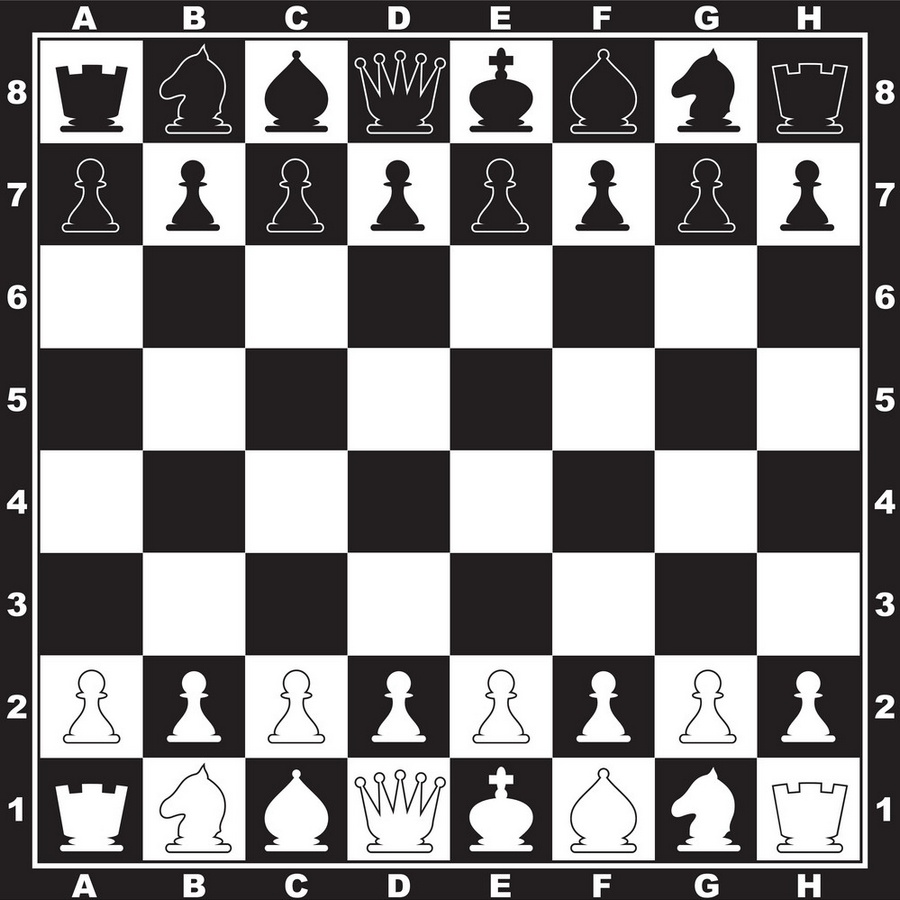
In the initial chess position, the rook in White's left hand corner is called Queen's Rook = QR, and the one in White's right hand corner King's Rook = KR. Additionally, Queen's Knight = QKt, King's Knight = KKt, Queen's Bishop = QB, King's Bishop = KB, Queen = Q and King = K.
The pawns are named after the pieces behind them. The King's Pawn, KP, is the one in front of the K, and so on.
The White army is classified into the Queen's side, or the left wing, and the King's side, or the right wing.
The Black army is classified in the same way: the Black Q is placed opposite the White Q, the Black K opposite the White K, the Black QR opposite the White QR, and so on. But Black's left wing is opposite White's right wing. Therefore, Black's left wing is his King's side.
The square in the bottom right hand corner of the chessboard is always a white one.
The Q stands on a square of her own color, the White Q on a white square and the Black Q on a black one, when the pieces are placed on the board for game play.
Position rules
During the course of the chess game, the players change the position of their pieces according to established rules. Chess players move a man from its square to another square. No two men are ever allowed to stand on the same square.
Whenever a man is moved to a square occupied by a hostile man, the hostile piece is captured and removed from the board. The players move alternately, and White makes the first move.
As discussed, each army consists of sixteen men: king, queen, rook or castle (2 pieces), bishop (2 pieces), knight (2 pieces) and pawn (8 pieces).
Chess glossary: chess terms from A to Z
Chess game terms, words and definitions in one list. Once you can tell a skewer from a pin, try the chess quiz.
A
- Advanced Pawn
- a pawn on the opposing player's side of the chessboard. An advanced pawn may be fragile if it is overextended or difficult to defend.
- Attack
- an aggressive action against a piece or a part of the board. It can be either short or long term, as with a mating attack.
B
- Back Rank
- a player's first rank, where the chess pieces stand in the opening array.
- Back Rank Mate
- checkmate by a rook or queen along the back rank, as the king is blocked in by his own pawns.
- Backward Pawn
- a pawn stationed behind the like-colored pawns on the neighboring files, which cannot advance with the support of another pawn.
- Bishop Pair
- a player's 2 bishops, one on the light squares and one on the dark squares. Perceived to be an advantage over two knights or a knight and a bishop.
- Bishops on Opposite Colors
- occurs when each side has a single bishop remaining, one on the light squares and the other on the dark squares.
- Blockade
- chess strategy of positioning a minor piece directly in front of an enemy pawn, where it stops the pawn and gains shelter from an attack.
- Break
- occurs when a pawn advance or capture opens up a blocked position.
- Breakthrough
- a sacrifice that results in the ruin of a robust defense.
C
- Capture
- to eliminate the opposing player's piece or pawn by using your chess pieces.
- Castling
- once in every game, the king has the option of moving two steps. This is done in the move called castling and is performed in combination with either of the rooks. It is performed in this way: the king moves two squares towards the rook, and the rook is brought to the square next to the king on the side farthest from the corner from which it was moved. The player cannot castle if either the king or the rook has been previously moved, if there is a piece between them, if the king passes over or rests on a square commanded by an opponent's piece, or if the king is in check.
- Check and Checkmate
- the king always remains on the board and cannot be taken like the other pieces. When he is attacked by a piece or pawn, he is said to be in 'check', a position of which the player receives warning by his opponent saying check! Under such circumstances, he must do one of three things: move out of check, put one of his pieces in the way, or take the piece that attacks him. In taking a piece, the king must move onto the opponent's square, as all other pieces must do. If the king can do none of these things, he is said to be checkmated, and he has lost the game. See also Simple Check, Discovered Check, Double Check and Perpetual Check.
- Chessboard
- has 64 checkerboard squares (8 rows x 8 columns) displayed in alternating light and dark colors.
- Connected Passed Pawns
- passed pawns on adjacent files.
- Connected Rooks
- occurs when 2 rooks of the same color are positioned on the same rank or file with no pieces between them.
- Counterplay
- active play by the player in a defensive position.
- Cover
- to either control a square or protect a chess piece.
- Cramped
- having limited movement.
- Cross-check
- a check in answer to a player's check.
D
- Decoy
- strategy to tempt an opposing player's chess piece to an undesirable square.
- Diagonal
- line-up of like-colored squares that touch at the corners, along which a queen or bishop can move.
- Discovered Attack
- an attack by a queen, rook or bishop that occurs when another chess piece or pawn moves out of its way.
- Discovered Check
- when, by removing a piece or pawn in front of a checking piece, an attacker is opened or discovered and puts the king in check.
- Double Attack
- two attacks that occur in one move, sometimes by the same chess piece.
- Double Check
- occurs when the adverse king is attacked by two pieces at the same time. The double check occurs in consequence of a discovered check.
- Double Pawn
- when two of your pawns stand on the same file, the front one is called a double pawn. The two are also known as doubled pawns.
- Drawn Game
- if neither player can checkmate his opponent, the result is a drawn game. There are several situations of a drawn game: by stalemate, by perpetual check, or when both parties persist in acting on the defensive. Also, when the forces on each side are equal or nearly so, for example queen against queen, with no effective resolution. Or when fifty moves have been made by each side without a capture or a pawn move.
E
- En Passant
- when a pawn has advanced to the fifth rank, and the opposite player pushes a pawn on a neighboring file two squares forward as its first move, the other pawn has the privilege of capturing it in passing. In other words, the pawn that has passed over the square guarded by the advanced pawn is liable to be captured just as if it had moved only one square. Or it may be allowed to remain, at the option of the other player. A pawn is the only piece that can use this move.
- En Prise
- a piece attacked by another is said to be en prise, or in danger of being taken.
- Escape Square
- available square that avoids an attack.
F
- Flank or the Wing
- refers to the queenside or kingside.
- Forced Move
- when a player can only make one single move.
- Forfeit
- loss of the game due to running out the clock or absence.
- Fortress
- placement strategy preventing the opposing player from penetration.
G
- Gambit Move
- a term derived from the Italian, used when a pawn or piece is purposely abandoned in the opening to gain an advantage in position. There are various kinds of gambits, like the King's Gambit. The pawn sacrificed is called the gambit pawn.
- Grandmaster
- next to World Champion, the highest title or goal for a chess player.
H
- Heavy Piece/Major Piece
- rook or queen.
I
- Interpose
- to bring a piece between your king, when in check, and the attacking piece. Additionally, this term is used when you cover your opponent's attack on any other piece with one of your own.
- Isolated Pawn
- a pawn standing alone, with no pawn of its own color on the neighboring files to protect it.
J
- J'adoube
- term used when a player touches a piece or pawn without the intention of moving it. It means 'I adjust'.
K
- Kick
- move by a pawn to attack an opponent's piece with the goal of forcing a move.
- Kingside
- the half of the board on which the kings stand in the beginning lineup of the game.
L
- Line
- opening for a bishop, rook or queen to control squares by a move.
M
- Man
- term used for any chess piece or pawn. Each player starts with 16 men.
- Mate
- abbreviation for checkmate.
- Mating Attack
- an attack whose goal is to checkmate the opponent's king.
- Minor Exchange
- a bishop in exchange for a knight.
- Minor Pieces
- the bishop or knight.
P
- Passed Pawn
- a pawn with no opposing pawn in front of it on its own file or on the neighboring files, so that no enemy pawn can stop its advance to the opposite edge of the chessboard. See also Promotion.
- Passive or Inactive Piece
- a piece that moves to or controls only a limited number of squares.
- Perpetual Check
- occurs when the opposing forces can occupy such a position as allows the adverse king no escape from one check without rendering him liable to another. This may occur when the king is attacked by one or more pieces, and if the player insists on repeating the check, the game is ended by being drawn.
- Pin
- a piece is pinned when it cannot move without exposing a higher value piece behind it to capture.
- Poisoned Pawn
- so named because this unprotected pawn, if captured, could result in the loss of the game.
- Promotion
- when a pawn has advanced to the opposite edge of the chessboard, it is exchanged for a queen, rook, bishop or knight.
- Protected Passed Pawn
- occurs when a passed pawn is supported by a second pawn.
- Push
- a pawn moved forward.
Q
- Queening a Pawn
- when a pawn that has reached the opposite edge of the board is exchanged for a queen, as it usually is.
- Queenside
- the half of the board on which the queens stand in the beginning lineup of the game.
- Quiet Move
- a move that neither attacks nor captures an opponent's chess piece.
R
- Rank and File
- as the pieces stand on the board at the start of the game, they are in two ranks. The horizontal rows of squares are called ranks, and the vertical rows files.
- Resign
- to give up the game before checkmate, or 'throw in the towel.'
- Royal Fork
- a fork, usually by a knight, that attacks king and queen at the same time.
S
- Simple Check
- when the king is attacked by a single piece or pawn.
- Skewer
- attack on a high value piece forcing a move to escape capture, thereby providing an opening to a lesser piece that may be taken.
- Smothered Mate
- a term employed when the king is surrounded by his own men and he cannot escape the attack of the adverse knight.
- Space
- number of squares controlled by a player. The player with the most squares is defined as possessing a spatial advantage.
- Stalemate
- position of the king in which, though not in check, he cannot move without going into check, while the player has no other piece or pawn that can move. Stalemate is a drawn game.
T
- Top Board
- player chosen to go up against the best opposing player.
- Touched Piece Rule
- occurs when a player touches a piece and in turn must move that specific chess piece. Also, should a player touch an opponent's piece, he/she is required to capture it if possible.
- Trap or Swindle
- the act of luring an opponent to play a losing move.
W
- Weak Square
- a square that is not easily defended against an attack.
- Winning the Exchange
- when you take a rook for a bishop or a knight.
More about chess
Ready for the next step? Two strategy articles build on this guide: chess attack strategy and chess game balance and values.
The longest game, the shortest win and the automaton that was shot by a sore loser are in the chess facts and trivia, and the chess quiz has 10 questions on the terms above.
Same board, different game: the checkers guide. Or browse all skill games.