

Three games played with tiles
Rules, terms and playing tips are published here for all three games. Pai Gow Poker is a derivative played with cards; the pai gow tile game, the game without cards, is different, as explained below.
These games have a common thread, in that all 3 tile games have a long history and boast passionate players worldwide. Let's begin with the game of mahjong.
Mahjong
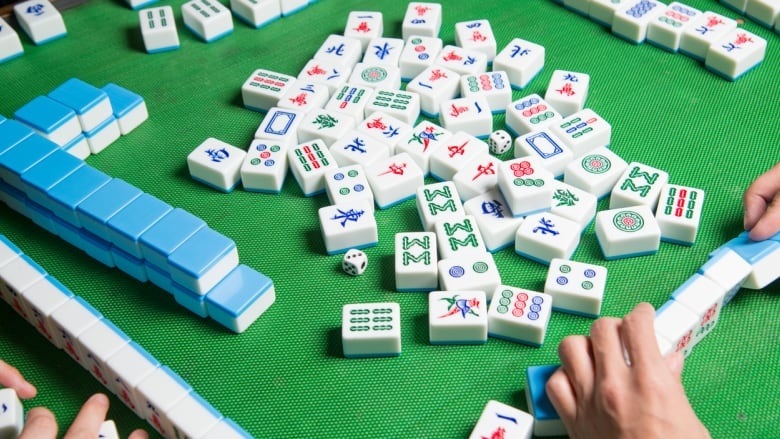
Mahjong introduction
The legends around the skill game of mahjong are older than the game. One dates it back to 500 AD, when the game is said to have become legal entertainment among the common people living in China, after being a lucrative pastime of the royal class only in the era of the King of Wu, over two thousand years back.
Another legend has it that the game was devised by Confucius, who traveled in China during that era. He was fond of birds, and perhaps that is why the game was christened mahjong, which denotes a sparrow. Some say that the three cardinal virtues professed by Confucius are represented by the three dragon tiles: red, green and white.
Historians trace the tile game as it is played today to China in the 19th century. Later, with cultural changes, the game was accepted as one of the most entertaining games not only in China, but in other countries as well.
Mahjong rules
The game is set with 4 players seated at a square table, representing the four wind directions of North, South, East and West. All tiles are placed face down, and after shuffling, each player selects a total of 36 tiles.
These tiles are arranged in 2 rows with an equal number of tiles in each, stacked one on top of the other. The dice are then rolled, and flower tiles are exchanged. The winning player completes a hand before anyone else. This completed hand has four sets of three tiles. Additionally, there is an identical pair of tiles.
Mahjong terms
Mastering this unique game is easier when one knows the terms of mahjong. Mahjong tiles have 3 divisions: Suits, Honor and Flowers.
- Suits
- can be Stones, Bamboo or Characters, depending on what the tile represents. For example, if a tile shows a number of bamboo sticks, it belongs to the Bamboo suit.
- Honor
- suit is further divided into Wind tiles and Dragon tiles.
- Flower
- suit has flower tiles such as plum, chrysanthemum, orchid and bamboo. These are four plants historically referenced by Confucius.
- Meld
- a set of tiles: a Pong, a Kong or a Chow. A player can complete a meld when an opponent abandons a tile and he or she calls or bids for it.
- Pong or Pung
- 3 identical tiles.
- Kong
- 4 identical tiles.
- Chow
- occurs when three tiles of the same suit are in sequence.
- Eye
- mahjong term for two identical tiles, the pair of a winning hand.
Mahjong bidding
Players use various types of bids, such as Tse, Pung and Gaung. If money is placed on the game, the loser has to pay the score difference between him or her and the winner.
The winner earns 20 points. The other players win points based on the type of tiles they have. Each tile has a certain amount of points. If you like playing games of strategy, you are sure to be drawn to mahjong.
Dominoes
The first brush with a skill game that most people experience is in the form of dominoes. After learning dominoes, one realizes the numerous possibilities and odds this game throws open.
Dominoes history
The name comes from the Latin dominus, which means master. It arrived at this name via the French winter hoods and the Venetian Carnival masks. The game, however, originated in Asia, like most of the non-card skill games.
The present day version can be attributed to the Chinese, who made it popular and standardized the game. The game was introduced and subsequently became popular in Europe in the 18th century.
Dominoes rules
The player who disposes of all tiles before the other players wins the game of dominoes. This player racks up points based on the other players' remaining tiles. The game begins with all tiles face down and shuffled, and each player selecting 7 tiles. The player holding the highest double tile starts the game.
Play proceeds in one of 2 ways:
- After the first player places a domino tile or bone, the next player has to match the pips at either end of that domino and place a tile accordingly. A player who does not have a match in hand must draw from the boneyard, the pile of dominoes not selected by the players.
- After the first player sets down a tile on the table, subsequent players have to play a tile whose end adds up with the open-ended pips to a previously agreed sum. For example, if the open end has 2 pips and the previously agreed sum is 9, then the next player has to play a 7.
Domino sets
Dominoes are made of ivory, wood, synthetic material and ceramics. The standard set holds all possible combinations of two dice, with ends ranging from 0 to 6. Sets can total from 28 to 190 tiles: popular sets are the double six, double nine, double 12, double 15 and double 18.
There are many other tile games that are a spin-off of dominoes or played with dominoes. Dominoes is also played professionally in tournaments and enjoys a special place among passionate players of skill games.
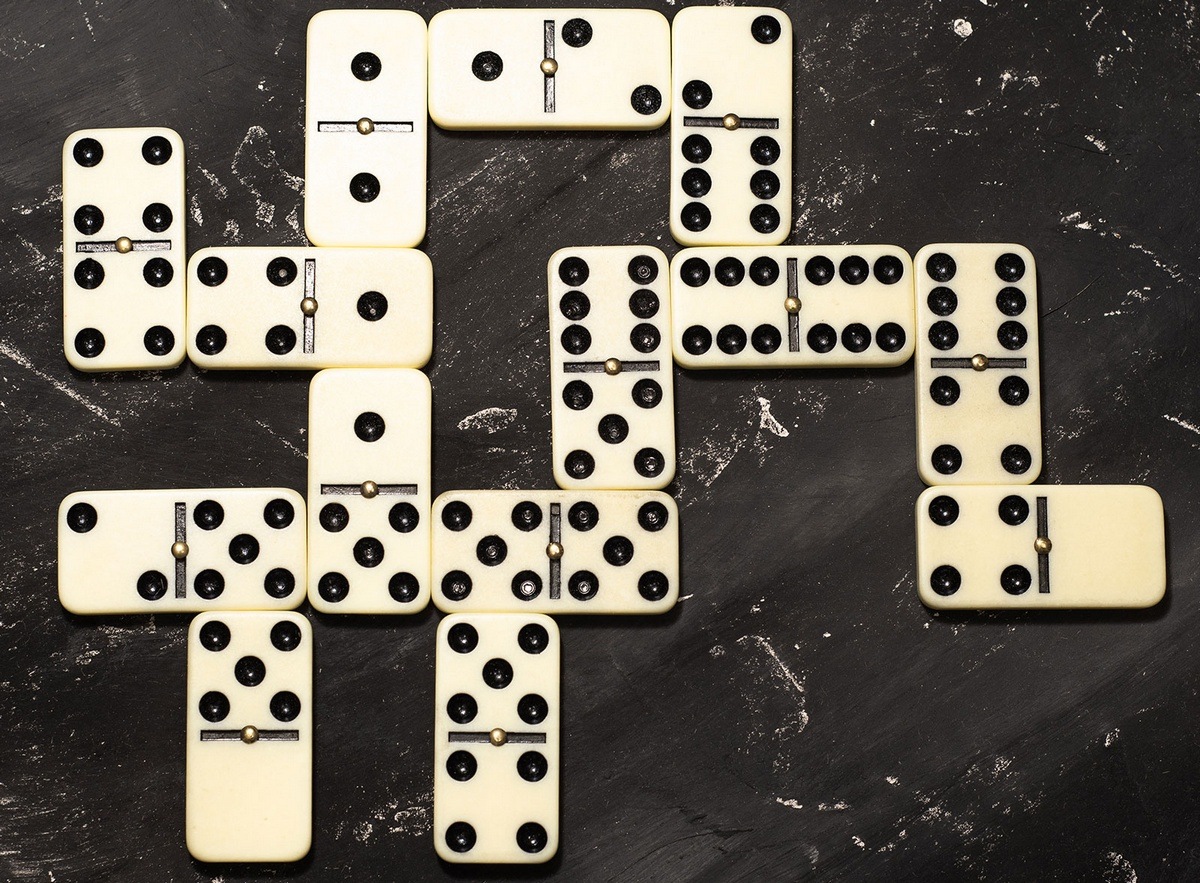
Domino terms
18 domino terms, from Ace to Tie Game.
- Ace
- a domino end with only 1 dot, pip or spot.
- Bar, Center or Divider
- term for the line separating the two ends of a domino.
- Blank, Zero, White or Pale
- refers to a domino end with no dots or pips. A double blank is a domino with both sides blank.
- Block or Jam
- term for a domino game where no player can make a move or advance, usually resulting in an end to the game.
- Bones
- another name for domino tiles.
- Boneyard or Reserve
- refers to the area where all dominoes are shuffled and placed face down, available for players to choose at the beginning of or during a game in progress.
- Deuce
- term for a domino end with 2 dots or pips.
- Domino
- a single bone or game tile, and/or the last tile to be played before the end of a game.
- Dot or Pip or Spot
- the marks that show the numbers on a domino tile.
- Double Value Tiles
- a set is named after its highest double. Example: a 0 to 12 set of tiles = double twelve, as the highest tile of this set has 12 spots on both sides. The number of tiles in a set also varies with the highest valued pip. A single tile is named after its two ends: a three-six is a tile that has 3 on one side and 6 on the other.
- Double or Doublet
- tiles with the same number on each side.
- Hand
- number of dominoes picked by each player to play that game.
- Open End
- term for the end of a tile not connected or linked to any other tile. Play can only continue at an open end.
- Rank
- is determined by the sum of pips. The higher the sum, the heavier the bone.
- Set
- action of placing a tile on the table, either at the beginning of or during a game. Also, if a player does not make his or her bid during the game, then he or she is set.
- Spinner
- term for the first double played in a game. Depending on the agreed rules, this domino tile can be designated to have 4 open ends available for play.
- Suit
- all tiles with a common end. Example: all tiles with 5 on one side belong to the suit of 5.
- Tie Game
- determined in favor of the first team in clockwise direction, counted from the first hand played. In the case of teams, the team with the lowest score wins.
Pai Gow
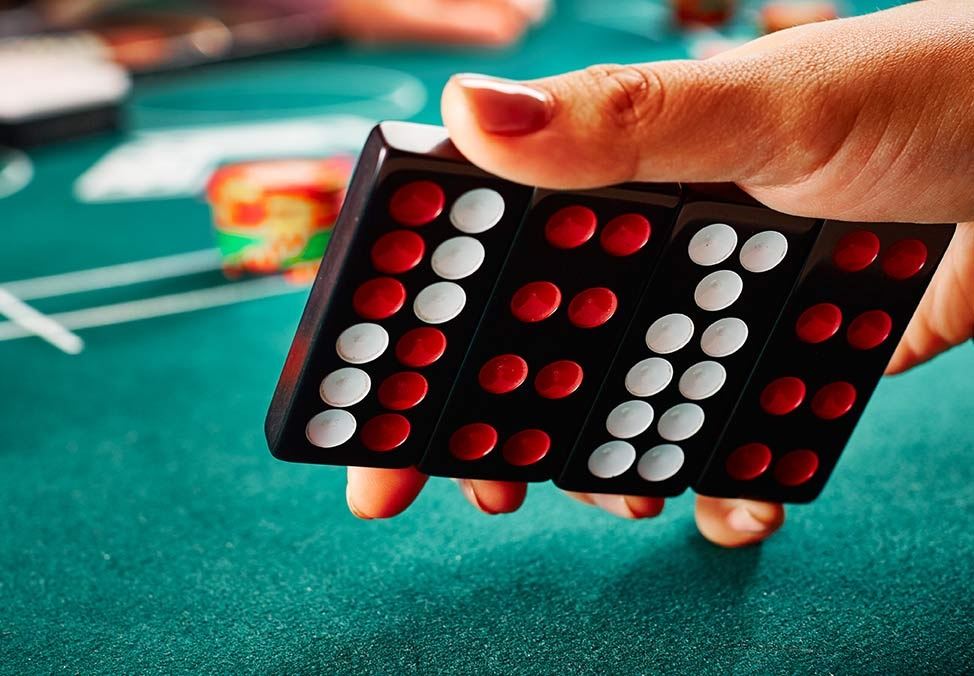
Pai gow rules
Ancient China has given us many gems, and this tile game happens to be one of them. Pai gow simply means to make nine; therefore, you have to get a tile score as close to 9 as possible.
Points are counted up to nine, after which the modulus 10 rule applies, with subsequent numbers starting again from 0. The woodpile is four tiles high and eight tiles wide.
The dice are thrown, the numbers added up and counted counter clockwise from the bank to determine which player is the first one to draw a hand. Each player gets a stack of four tiles.
At the start, the banking authority resides with the house, but as play progresses, the bank is passed around to the other players in counter clockwise direction. A player can refuse to take on the bank.
The dealing is referred to as pai gow cuts. The game can have up to eight players, one being the banker. Later, any number of people can chip in.
Each player has two hands in the game. This is done by dividing the four tiles into sets of two. The usual chips are used as stakes: play money at home, and at the casino chips that can be cashed in later.
Winning at pai gow
The game is won when a player's high hand beats the bank's high hand, and the player's low hand beats the bank's low hand.
If only one of the hands of a player outranks the bank, the game is drawn and the player gets his or her money back. If both of the bank's hands outrank the player's hands, then he or she loses the game.
Once all the players have examined their tiles and placed their stakes, other people can participate by tossing in their stakes alongside the players. Also, the banker can set an upper limit for the stakes.
The players then show their high hands in counter clockwise direction from the bank. The bank then reveals its high hand.
This procedure is followed by the players showing their low hands, as does the bank. Either the bank or a player has to outrank the other on both hands to win a round.
There is the possibility of a draw, with each side winning one hand. The bank pays the winning players plus the people who had bet with these players, in line with their stakes. The game continues with the player to the banker's right taking over the bank in the following rounds.
Pai Gow Poker is an American derivative of pai gow played with standard playing cards, requiring that the player set two hands, a high and a second highest, trying to beat the banker's two hands. It should not be confused with pai gow, the tile game. The Pai Gow Poker rules are detailed with the poker terms.
Pai gow strategies
Keep in mind that even one point is enough to beat the bank's hand, so pairing up the good tiles for a strong high hand and leaving the weak tiles for a low hand will only result in a draw. Balance out the tiles properly and win the game.
Look out for the unmatched pairs that might give you a winner. If you get a [6-6] or [1-1], play them with tiles totaling 7, 8 or 9. Be certain that you make the required 9 and you will be in the game!
More skill games
Dice in place of tiles: the dice games, with Sic Bo, another game from China. Lettered tiles are at home with the types of word games, and melds, sets and runs with the rummy terms. Or browse all skill games.