

Ten games, one thing in common
Scoring and playing tips are described for all these unique skill games. Another common feature of dice games is that the enjoyment and excitement of play is shared by passionate gamers worldwide, which deserves a spot in the gamerisms skill games section.
Poker Dice and Yahtzee are at the top of this skill games list, followed by Boggle, Bunco, Kismet, Farkel, Shut the Box and Stack. Sic Bo and craps, likely the most recognized true gambling games, complete the list of 10.
10 popular dice games: rules and scoring
Open one of the dice games below to read more about it.
1. Poker Dice
Poker Dice rules
Poker Dice is one of the most famous dice skill games. The die used in the game is a six-sided cube displaying cards instead of numbers. The six sides represent Ace, King, Queen, Jack, Ten and Nine, used to form a poker hand in order of rank.
In order to win the game, a player has to roll the best poker hand combination. The game is played with five dice by two or more players. After the ante, each player in turn rolls the five dice and plays for the best hand.
Each player takes up to three rolls of the dice. If a player is not satisfied with the combination on a roll, he or she is allowed to set aside any dice and roll the others again. This can be done a maximum of 2 times; then the player must take the resulting hand without making any changes to it.
A player who is satisfied may stop after one or two rolls. In many games, the number of rolls taken by the first player is then the limit for the players who follow. When every player has rolled, the best hand wins the pot.
Poker Dice hands
The hands of Poker Dice, from the highest to the lowest:
- Five of a kind = all five dice show the same face, for example J-J-J-J-J.
- Four of a kind = four dice of the same face, for example 10-10-10-10-A.
- Full house = three of one face and two of another, for example K-K-K-9-9.
- Straight = five faces in sequence. There are only two: A-K-Q-J-10 and K-Q-J-10-9.
- Three of a kind = three dice of the same face, for example 9-9-9-K-J.
- Two pair = two pairs of different faces, for example Q-Q-9-9-A.
- One pair = two dice of the same face.
- Bust = five different faces that do not form a straight.
As the dice have no suits, there is no flush and no straight flush. The straight is ranked below the full house by tradition, as in card poker; some house rules rank it higher or count it as a bust, so agree on this before the first roll.
Ties are broken by the dice used in the combination, with the ace as the highest face, and then by the dice not counted in the combination. Four aces beat four kings, and K-K-K-K-J beats K-K-K-K-10.
Poker Dice playing tips
One pair is the most common result of a single roll of five dice, at about 46%, so a pair alone rarely wins. Keep the pair and roll the other three dice for three of a kind or better. Five of a kind on a single roll is a 1 in 1,296 shot, the same odds as a Yahtzee on the first roll.
2. Yahtzee
Yahtzee rules
Yahtzee was first marketed by Edwin S. Lowe in 1956. Milton Bradley bought his company in 1973, and the game later came to Hasbro Inc. Along with the classic version comprised of dice and scorecards, Yahtzee products have evolved to include a dice holder, dice tray, travel edition, key chain and a popular slot machine.
This recognizable brand of dice games is played with five dice that are rolled at once. The rolled combinations determine the points scored by the player. The object of Yahtzee is to score the most points over the 13 rounds of the game.
Players roll the dice up to three times in a turn and select the best combination to receive maximum points. The game ends after 13 rounds, and the scores are tallied to determine a winner. The scores of all rounds are entered in a score sheet or scorecard. All 13 dice patterns are printed there, along with an empty box where the score for each round is entered.
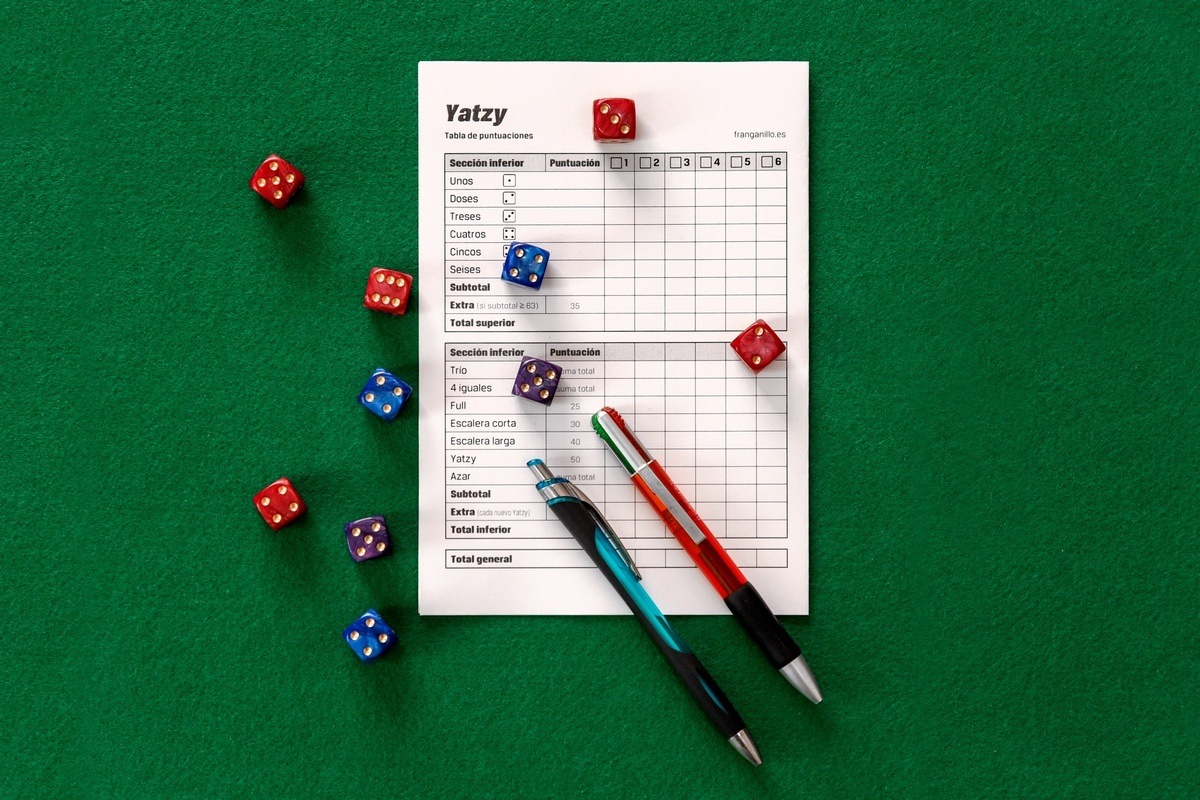
Yahtzee scoring
A maximum of 375 points can be achieved in a game without bonus Yahtzees. The top combination is the Yahtzee itself, five dice of a kind, which is a 50-pointer. The lowest possible roll totals 5: five 1's.
The probability of a Yahtzee within the three rolls of a turn is approximately once (1) in 22 attempts. And the probability of it on the first roll of any turn is low, at 1 in 1,296 attempts. Thus, a player's choices after a roll, saving or tossing the dice rolled, are critical, and the reason Yahtzee dice games are considered skill games.
Yahtzee has been described as a tactical game, a strategy game and a mind game; however, the global appeal of the game beats everything else.
3. Boggle
This classic game, available online and off, consists of 16 dice cubes marked with a different letter of the alphabet on each of the 6 sides of an individual die.
Scoring is determined by the number of words consisting of 3 letters or more that are formed after the cubes are shaken into their tray.
Words can be formed by joining letters up, down, side-to-side and diagonally. The longer and more unusual the words, the higher your score. More games with letters are among the types of word games.
4. Bunco
Bunco has a long history and an excitement that has endured for this fast-paced game. Played by a group of 4-12 players, the game consists of 6 rounds with a target number of 1 to 6 for each round. Players who roll three of the designated target number score a BUNCO!
For example, rolling three 4's in Round 4 or three 6's in Round 6 is a Bunco. The player must call out Bunco to receive 21 points on the score card. Otherwise, rolling three of a kind other than the target number of the round scores 5 points. For example, rolling three 6's in Round 4 is worth 5 points.
Round: a full turn of one target number. Each set is broken down into 6 rounds.
Set: Bunco is divided into 4 sets. 1 set equals 6 rounds.
Roll-Off: in the event of a tie, a Roll-Off is one complete turn around the table. The team or player with the most points after the Roll-Off is the winner.
5. Kismet
Luck meets skill with the tri-colored dice game of Kismet. The game is played with 5 tri-colored dice, and scoring is determined by the color and number combinations rolled.
Players roll any or all dice one, two or three times, looking for dice combinations formed according to a designated scoring category. Players fill 15 scoring boxes and add bonuses for their total game score. The player with the highest total score wins the game. If Yahtzee is a favorite of yours, you are likely to enjoy the game of Kismet also.
6. Farkel
Farkel, also spelled Farkle, combines poker, skill and risk to create a high-scoring dice game. Players roll six dice with the goal of scoring points for combinations such as 3-of-a-kind, 4-of-a-kind, a straight, etc. You continue to roll until a roll appears with no scoring combinations, known as a Farkel, at which time you lose all points gained in that turn. The risk comes into play when, after each toss of the dice, you are faced with the 'take the points or gamble for more' question. The first player to score over 10,000 points wins.
7. Shut the Box
Shut the Box is played with a unique set of hinged tiles, numbered 1 to as high as 12, along with the required pair of dice.
Also called Tric-Trac, Canoga or Batten Down the Hatches, the road to a win for this game is to 'Shut the Box' before your fellow challengers.
Each player rolls the dice and lays down any combination of tiles that matches the roll. Thus, if your roll is a 7, you can lay down either the 7 tile, or the 5 and the 2, or the 4, 2 and 1 tiles. In the event that every tile higher than 6 is covered, the player has the choice of rolling one or two dice. Your turn continues until no match can be made on the remaining tiles, at which time your score is recorded. All the tiles are flipped up, and the turn passes to the next player. After each player has played, the game is over, and the low score wins. Any player who lays down all the tiles has "Shut the Box".
8. Stack
This skill game merges strategy, defense and stacking with a pile of colored dice to create rolling good times. The winner is determined by the highest number of points. Each player has 14 dice of one color in play. Each Stack set of 56 dice is divided into 4 colors: red, yellow, blue and white, or black, purple, green and pink, and comes with 1 Stack Sack (say that 3 times).
Once the dice are rolled by each player and the first challenger to play is determined, a clockwise rotation ensues. The first player then stacks a cube on an opponent's cube with the same number. Example: a 5 on top of a 5 facing up, etc. Once stacked, the cubes cannot be moved or relocated. A player cannot stack directly on top of his or her own cube, but is allowed two dice of his or her color in a stack.
Once a fourth cube is stacked, that pile is captured and taken out of play, while the points are credited to the player who placed the last or fourth cube on the stack. Instead of stacking, a die can be selected and rolled for a higher number; however, that roll must be used or the turn is over.
When a player is about to stack his or her last die, the other players are notified. The player about to stack the last die and the opponent who received this stack are then out of the round, and the remaining players are given one last turn.
Afterwards, the round ends and scores are tallied. Each stack of two or more dice belongs to the player whose color is on top.
Stack scoring
All dice or cubes count their face value, except for the 1, which has a value of 10.
Stack penalties
- If a player rolls a die and knocks a stack over, he or she loses a turn and must roll a die and subtract the amount from the score. If that stack cannot be rebuilt, the player loses an additional 10 points.
- If a player picks up an opponent's colored die by mistake, she or he loses a turn. If a player accidentally rolls the opponent's die, the opponent has the option to keep the new number or return it to the original number.
- If a player goes out of turn, he or she loses a turn.
9. Sic Bo
Sic Bo rules
The modern version of this game is played with three dice and a cage shaker, on a table with pictures displaying the 50 possible bets and their corresponding payouts.
Sic Bo means precious dice, and three of them are in play. This game with a long history has evolved into a game of worldwide interest and is offered at many online casinos today.
The goal of the game is to bet on the possible results, or a combination of results, of the three dice. Players bet their chips on any of the pictures on the table. The dealer then shakes the dice in the cage and rolls them out. If a winning combination is hit, the picture square lights up and the player is paid accordingly.

The odds, and accordingly the house edge, are calculated based on the complexity of the prediction or bet.
Example: bet = the total score will be between 11 and 17 inclusive; the exception is a triple. Probability of occurrence = 48.61%. Odds = 1 to 1 and house edge = 2.78%.
Thus, if a player places a bet on the sum total of the result being between the numbers 11 and 17, this example considers all possible combinations of numbers on the three dice. The chance of them adding up to these totals turns out to be almost 50%, thus the odds are 1:1, or hit or miss.
Sic Bo betting
Bets can be placed on these results, starting with low odds of 1:1:
- Even scores = even sum
- Odd scores = odd sum
- Specific doubles or two of a kind = the given number showing up on 2 dice, with the exception of triplets
- Any triples = all dice turn up with the same number
- Specific sum totals
- Dice combinations = any two given numbers
- Four number combinations
- Three single number combinations
- Specific double
- Single number combinations
The odds fluctuate between 1:1, 1:1, 10:1, 30:1, 60:1 to 6:1, 6:1, 7:1, 30:1 and 50:1 respectively. The odds listed here might not be the same in every casino, as individual casinos set their own payouts and house edge.
10. Craps
This list would not be complete without the mention of craps, the global game of dice covered extensively at gamerisms.
There is a craps guide, a craps facts and trivia report and a craps quiz at the site. The rules of the game are described here briefly.
Let's run through the numbers on the first roll: 2, 3 and 12 are craps, the losers. 7 and 11 are natural winners. The point numbers are 4, 5, 6, 8, 9 and 10, and these points must be repeated before a 7 is rolled.
More skill games
Dice also decide the moves in backgammon and the deal in mahjong and pai gow, two of our tile games. For games without luck of the roll, see the types of puzzles. Or browse all skill games.