

What is billiards?
The equipment required for a game of billiards is a table that measures 12 feet by 6 feet with 6 pockets. It is played with one red ball and two white cue balls, one of which has a small black spot whereas the other one does not.
The balls are struck with a tapered stick called a cue, which ends in a leather tip. Other accessories for billiards are the rest, the full-butt and the half-butt, which are used to support the cue on long shots, when the cue ball is out of reach.
A singles game of billiards is generally played rather than doubles. A player's turn is a series of strikes to the cue ball that lasts as long as he keeps scoring, and the points made in one turn are called a break. When a ball is knocked into a pocket, it is said to be potted.
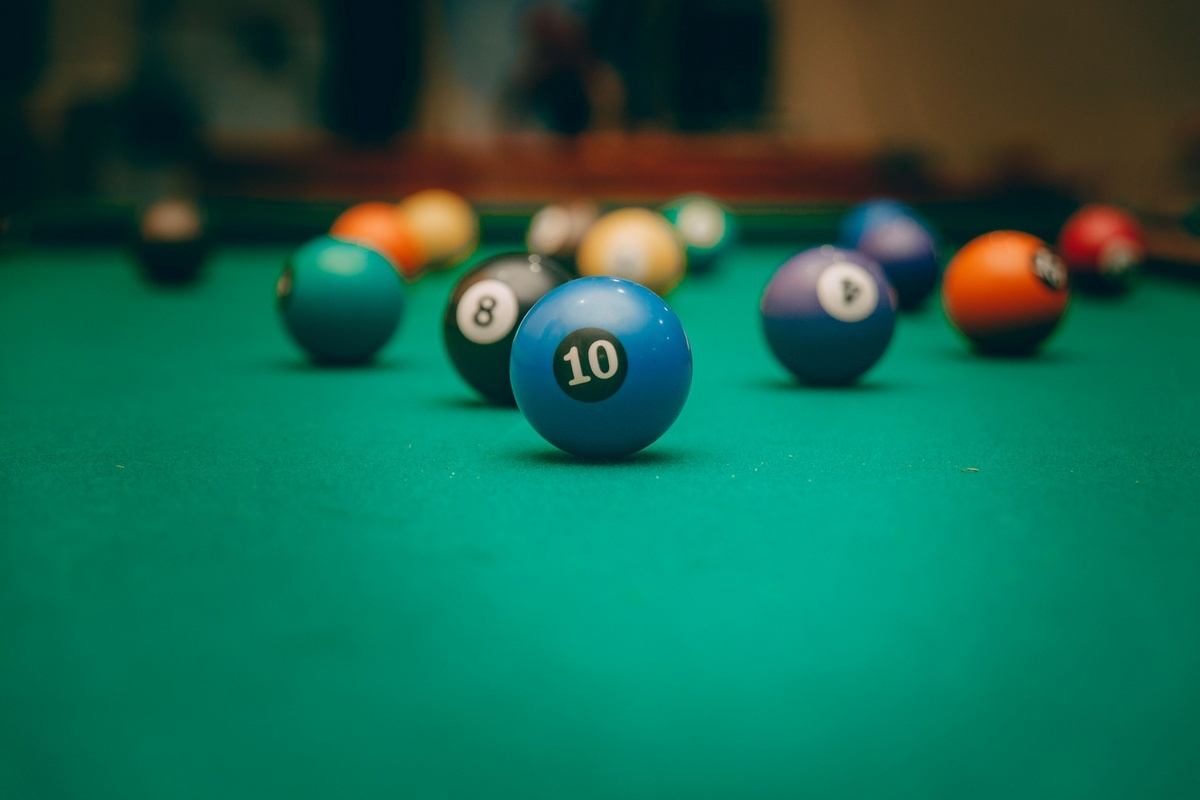
The pocket games played with numbered balls, such as 8-ball and 9-ball, are better known as pool.
The four games come first, followed by the billiards glossary from A to Z. For the stories behind the game, read the billiards facts and trivia.
Billiards variations: 8-ball, 9-ball, snooker and carom
Pick one of the billiards versions below to read more about it.
8-Ball
The object of the game is that one player pockets the balls numbered 1 through 7, the solid colors, while the other player pockets the balls from 9 through 15, the stripes. The player who has pocketed all the balls of his group is then allowed to legally pocket the 8-ball and thus win the game.
9-Ball
This billiards version is played with 9 object balls numbered from one to nine along with the cue ball. The first contact made must always be with the lowest numbered ball on the table, and it does not matter which ball is potted. After the first player misses, the second player takes over from the position where the first player left off. The game is won by pocketing the 9-ball.
Snooker
The cue ball is used to strike and pocket the object balls in one of the 6 pockets. Snooker is played with 1 white cue ball, 15 red balls worth one point each and six balls of other colors, each assigned points: yellow = 2 points, green = 3, brown = 4, blue = 5, pink = 6 and black = 7. The balls are potted in a sequence, a red and then a color in turn, and points are awarded accordingly.
The player with the most points wins the frame. A match is played over an agreed number of frames, for example the best of 19, and the player who wins the most frames is declared the winner of the match.
Carom
French billiards or carom is played with three balls, white, red and white with a spot, on a table without pockets. The objective of this game is to drive one of the white balls, the cue ball, into both the other balls, and by doing so the player earns one point.
When one player fails to score, the play passes to the other player, who plays the balls as they were left. The game continues until one player reaches an agreed number of points, which is often 50.
Billiards glossary: billiards terms from A to Z
Billiards terms, pool lingo and snooker jargon in one list. Where a term belongs to one game only, the definition says so. Once you know your kiss from your kick shot, try the billiards quiz.
A
- Angled
- in snooker, when the corner of a pocket hinders a player shooting the cue ball directly at an object ball. See also Corner-hooked.
- Apex
- positioning of the front ball in the rack or pyramid of object balls.
- Around the Table
- in carom, term used when the cue ball contacts 3 or more cushions in order to score.
B
- Balance Point
- point at which the cue will balance when lying on one hand. It is approximately 18 inches from the bottom of the cue.
- Ball On
- snooker term for any ball that may legally be struck first by the cue ball: a red, or the color that is next in turn.
- Bank Shot
- also referred to as bank. When an object ball is driven to one or more cushions or rails before being pocketed.
- Baulk-line
- in snooker, the line drawn across the table 29 inches from the bottom cushion.
- Billiard
- in carom games, a count or score.
- Black Ball
- in snooker, the black ball is the highest valued colored ball, worth 7 points.
- Blind Draw
- jargon for random selection of tournament players.
- Blood Test
- a very tough shot that has to be played under pressure.
- Blue Ball
- in snooker, the blue ball is worth 5 points.
- Break
- opening shot in pocket games or carom, whereas in snooker it is the total of points scored in one inning.
- Breaking Violation
- in pocket billiards, a breach of the rules that apply to the opening break.
- Bridge
- the hand position, or the device, that supports and guides the shaft of the cue during a shot. See also Crutch and Rest.
- Brown Ball
- in snooker, the brown ball is worth 4 points.
- Burst
- in the game of forty-one pocket billiards, when the total score is more than 41 points.
- Butt of Cue
- term for the thicker end of the cue, the opposite end from the tip.
C
- Called Ball
- the ball specified or indicated by the player to be pocketed on a shot.
- Called Pocket
- the pocket into which the player says the called ball will go.
- Cannon
- British term for a carom.
- Carom
- jargon for the bounce of the cue ball off one ball into another. Also the family of games played on a table without pockets.
- Center Spot
- the center point of the table playing area.
- Chalk
- dry substance that is applied to the tip of the cue to prevent slippery contact with the cue ball.
- Clean Bank
- in bank pool, a bank shot in which the object ball touches no other object ball on its way to the pocket.
- Clear Ball
- lingo for the unmarked white ball in carom.
- Combination
- shot in which the cue ball drives one object ball into another object ball to pocket it.
- Combination On
- term for 2 or more balls placed so that a ball can be driven into a called pocket with a combination shot.
- Contact Point
- the exact point at which the cue ball and the object ball touch.
- Corner-hooked
- occurs when a pocket corner impedes a cue ball shot to the object ball.
- Count
- a shot where one or more points are scored.
- Cross Corner
- jargon for a bank shot that rebounds from a cushion into a corner pocket.
- Cross Side
- jargon for a bank shot that rebounds from a cushion into a side pocket.
- Cross Table Shot
- in carom, occurs when the cue ball travels across the table between the long cushions to score.
- Crutch
- jargon for a mechanical bridge.
- Cue
- tapered wooden stick that is used to strike the cue ball.
- Cue Ball
- the white, unnumbered ball that is struck with the cue.
- Cue Ball in Hand
- occurs when the player may place the cue ball by hand, anywhere on the table or within the area that the rules of the game set.
- Cue Tip
- end of the cue shaft that touches the cue ball on a shot.
- Cushion
- rubber, covered by cloth, that borders both billiards and carom tables, creating the playable area.
D
- Dead Ball
- term for a cue ball that loses its speed after contact with the object ball. Also Kill Shot.
- Double Elimination
- term for a tournament in which a player is eliminated after 2 match losses.
- Double Hit
- when the billiard cue tip strikes the cue ball twice on the same shot.
- Double Round Robin
- each participant in these tournaments plays all their opponents twice.
- Drop Pockets
- term for pockets without a ball return: a pocketed ball stays in the pocket until it is taken out by hand.
F
- Feather Shot
- jargon for a cue ball that only brushes the object ball.
- Follow Shot
- occurs when the cue ball moves forward after touching the object ball.
- Foot of Table
- the end of the table where the balls are racked.
- Force
- the power applied on the cue ball that affects the movement of the ball.
- Force Draw
- shot played with extreme draw, so that the cue ball comes back a long way after hitting the object ball.
- Foul
- a violation of the rules that results in a penalty.
- Foul Stroke
- shot that results in a foul.
- Frame
- term for a snooker game.
- Free Ball
- in snooker, occurs after a foul that leaves the next player snookered. That player may nominate any ball as the ball on, and it counts for the value of the ball on.
- Frozen
- refers to one ball touching another ball and/or a cushion.
- Full Ball
- jargon for the cue ball hitting the intended ball head-on, along the line through the centers of both balls.
G
- Game Ball
- the ball that, if pocketed legally, concludes the game and names a winner.
- Gather Shot
- in carom, term for a strategic shot that brings the balls together and so allows for an easy score on the follow-up shot.
- Green Ball
- in snooker, the green ball is worth 3 points.
- Grip
- manner in which the thicker end of the cue is held.
- Gully Table
- term for a design that returns pocketed balls to the end of the table.
H
- Handicapping
- variations of scoring or rules given to less experienced players, thus allowing an even game for all participants.
- Head of Table
- the end of the table from which the opening break of the game is played.
- Hickey
- in snooker golf, refers to any foul committed by a player.
I
- Inning
- a player's turn at the table. It has no set length and lasts as long as the player keeps scoring legally.
J
- Jaw
- term for the angled portion of the cushion just before the pocket.
- Jawed Ball
- lingo for a ball that does not drop but remains just outside the pocket.
- Joint
- term for the device in the middle of the cue that allows for separation into 2 sections.
- Jump Shot
- shot that causes the cue ball or an object ball to rise off the table.
- Jumped Ball
- jargon for a hit ball that has 'jumped off' the table or over another ball.
K
- Kick Shot
- refers to a shot where the cue ball hits a cushion before touching the object ball.
- Kiss
- refers to the contact between balls.
L
- Lag
- in carom, refers to a shot in which the cue ball contacts 3 or more cushions before the object balls.
- Lag for Break
- system where each participant shoots a ball to the foot cushion and back, and the player whose ball stops closest to the head cushion is the starting player.
- Leave
- position of the balls after a strike has been made by a player.
- Losing Hazard
- in English billiards, occurs when the cue ball is pocketed after contact with an object ball.
- Lot
- methods employed (drawing cards, peas or pills and the flip of a coin) to establish a starting player.
M
- Masse
- shot played with the cue held almost upright, which puts so much spin on the cue ball that it travels in a curve.
- Match
- the course of play from the lag at the start to the end of the last game, with no set time limit.
- Miscue
- flawed contact between the cue tip and the ball.
- Miss
- occurs when a player fails to execute a proper shot.
N
- Natural
- a shot in carom games that is easy and completed as expected.
O
- Object Ball
- any ball on the table other than the cue ball.
- Open Break
- rule that the breaking player needs to drive at least 4 object balls to the cushions.
- Opening Break Shot
- the first shot made by a player in a game.
P
- Peas or Pills
- small plastic or wooden balls numbered 1 through 15 or 16, drawn by lot in some pocket games.
- Pink Ball
- in snooker, the pink ball is worth 6 points.
- Position
- strategy to place the cue ball so that it is in an advantageous spot for the follow-up shot.
- Pot
- when the object ball is pocketed.
- Power Draw Shot
- term for excessive draw applied to the cue ball. See also Force Draw.
- Push Shot
- shot where the contact between the cue and the cue ball is longer than the time allowed in a legal shot.
- Pyramid
- the triangular positioning of the object balls in a rack before a game starts.
R
- Race
- term for the established number of games required to win a match or a set.
- Rails
- term for the area of the table not covered by cloth. Due to the shape of the table, there are short and long rails.
- Red Ball
- term for the red object ball in carom and English billiards. In snooker, one of the 15 reds, worth 1 point each.
- Rest
- jargon for the mechanical bridge in snooker.
- Round Robin
- each participant in these tournaments plays all their opponents once.
- Run
- term for the total of points or counts scored consecutively by a player in 1 inning.
S
- Safety
- strategic positioning by a skillful player to reduce the opportunities for an opponent to score.
- Scratch
- in carom, occurs when a point is scored by an unplanned shot. In pocket games, when the cue ball is pocketed on a stroke.
- Seeding
- occurs during tournaments when pairing and positioning are established.
- Set
- term for an established number of games required to win a match.
- Short-rack
- pocket games using fewer than 15 object balls.
- Shot
- term for the contact between cue and ball, concluding when all action on the table has stopped.
- Shot Clock
- timer used to limit the time a player takes for a shot.
- Single Elimination
- term for a tournament where one loss will result in elimination.
- Snookered
- when the cue ball cannot be shot in a straight line at the ball on because another ball is in the way, often following an opponent's safety shot. The player is said 'to be snookered.'
- Split Double Elimination
- tournament in which the field is divided into 2 sections, and the winners of the 2 sections vie for the championship.
- Split Hit
- jargon for a shot where it cannot be established which object ball the cue ball hit first, because the balls are so close together.
- Spot
- another term for a handicap, wherein a player is given points based on level of play.
- Spot Ball
- in carom, the white ball that has markings to tell it from the clear ball.
- Spot Shot
- a shot at a ball that sits on the foot spot.
- Spotting Balls
- term for putting specific balls back on the table according to the game rules.
- Stance
- body position during shooting.
- Stop Shot
- jargon for a shot at the intended ball where the cue ball stops abruptly.
- Striker
- player who is about to make a shot.
- Successive Fouls
- term for pocket game fouls made by the same player, one turn after another.
T
- Table in Position
- occurs when the expected ball does not move after a shot taken.
- Time Shot
- in carom, term for a sequence where the cue ball moves other balls, yet drives on to score from one of the moved balls.
- Top Cushion
- the cushion at the foot of a snooker table, nearest the black spot.
- Triangle
- term for the piece of equipment used to rack the balls to begin a game.
Y
- Yellow Ball
- in carom, replaces the spot ball in international games. In snooker, the yellow ball is worth 2 points.
More about billiards
Who owned the first indoor billiard table, and why is the cloth green? The answers are in the billiards facts and trivia. Then chalk up for the billiards quiz: 10 questions on the terms above.
More games of a steady hand and a good eye: the darts guide, or browse all skill games.