

What is tennis?
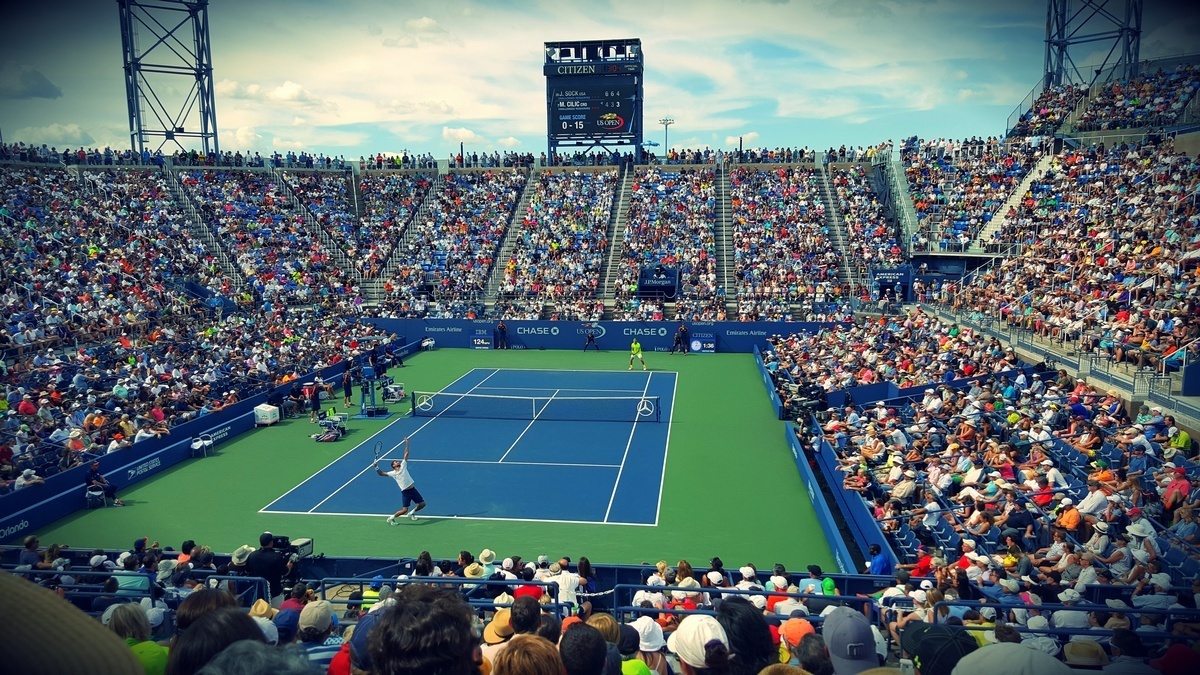
Tennis became popular in the 19th century among the high society in England as a lawn game. Tennis is a game played between two individuals or two teams of two players on a field or court, with a net placed between to separate the sides.
A hollow ball, typically made of hard rubber and covered in a type of felt, is hit back and forth across the net with paddle-like racquets that are strung to hit the ball into the opponent's half of the court. Tennis courts were traditionally made of grass, but can also be made of clay or some other type of hard surface such as concrete or asphalt, and occasionally even carpet in the case of indoor tennis.
Tennis glossary: tennis terms from A to Z
Tennis terms, lingo and jargon in one list. Once you can tell a bagel from a breadstick, try the tennis quiz.
A
- Ace
- a serve that is in bounds on the opposing player's side of the net and goes untouched, resulting in a point awarded. A smooth move!
- Ad Court
- the side of the court to each player's left.
- Advantage
- a point more than deuce in a tied game, giving the player that scores it the advantage and positioning him/her one point from winning the game.
- Advantage In
- jargon for server advantage.
- Advantage Out
- refers to receiver advantage.
- All
- scoring term for a tie, example 30-all.
- All-court
- a type of play encompassing many different playing styles.
- Alley
- the outer strips of the court between the singles and doubles sidelines.
- Approach Shot
- a shot hit on the way to the net, typically with spin on the ball.
- Australian Formation
- in doubles tennis, the strategy of both players playing the same side of the court prior to the start of the point.
B
- Backcourt
- court area from service line to baseline.
- Backhand
- hitting the ball with the back of the racquet hand facing the ball, the arm reaching across the body.
- Backspin
- a shot in which the ball has a reverse spin on it, caused by hitting the ball in a downward slicing motion.
- Backstop
- term for the fence or wall behind the court end that stops the tennis balls.
- Backswing
- the part of the swing where the player's arm is making a backward motion in order to build momentum to return the ball.
- Bagel
- term for the '0' that represents a bagel in a 6-0 win or a 0-6 loss.
- Ball Boy or Ball Girl
- male or female given the task of chasing the balls during a match.
- Ball Toss
- occurs before executing a serve.
- Baseline
- the end boundary stretching the width of the court.
- Baseline Game
- method of play where most shots are hit from near the baseline.
- Baseline Judge
- game official whose duties are calling the shots in or out at the baseline.
- Baseline Player
- term for a player utilizing a baseline method of play.
- Big Serve
- lingo for a powerful serve, usually in a clutch situation. Faster than a speeding bullet!
- Block
- typically a service return: the act of using the racket to block the ball, rather than hit it.
- Breadstick
- slang for the shape of the 1 in a 6-1 win or loss.
- Break
- the winning of a game when the player is not the server, hence the breaking of the serve.
- Break Back
- jargon for a player who has just lost a service game winning the opponent's serve in return.
- Break Point
- one point away from winning a game against the serve.
- Buggy Hit
- the act of hitting the ball with no follow through but a short whip-like motion.
- Bye
- occurs when top players qualify to advance without playing a match.
C
- Call
- the umpire's decision to rule on a play during a match.
- Cannonball
- lingo for a hard serve, usually on a flat trajectory.
- Carry
- illegal action where the ball is held or carried on the racket, as opposed to hitting the ball.
- Carve
- a groundstroke hit with spin on it.
- Center Court
- the main court of a tennis venue, with the premium seating.
- Center Mark
- term for the mark at the baseline midpoint, which is 2 X 4 inches.
- Center Service Line
- marks the boundary between the two service courts.
- Centerline Judge
- game official who is responsible for monitoring and calling the center service line.
- Chair
- the location of the game umpire.
- Changeover
- the time when players switch ends of the court, after every odd-numbered game of a set.
- Chip
- a shot with underspin that is typically a block.
- Chop
- jargon for a tennis shot struck with a rapid downward action, having plenty of backspin. Whoa, that's a spinner!
- Clean Winner
- tennis shot that the opposing player is unable to reach and play.
- Closed Grip
- grip where the racket face is pointing down.
- Closed Racket
- jargon for a racket held with a closed grip.
- Closed Stance
- hitting the ball with your back turned to your opponent and your body parallel to the baseline.
- Court or Tennis Court
- measures 78 feet long X 27 feet wide for singles and 36 feet wide for doubles, with a net in the middle. Service lines are marked 21 feet from each side of the net and parallel to it.
- Crosscourt
- a shot that travels diagonally into the opponent's side of the court.
- Cut To
- quick, slicing downward movement resulting in sidespin and backspin.
- Cyclops
- a computer powered device that was used to determine if a serve was in bounds or out, before camera systems took over.
D
- Daisy Cutter
- jargon for a low shot with backspin resulting in a low bounce.
- Dead Net
- the accidental shot that hits the net and falls into the opponent's side of the court. Betcha can't do that again!
- Default
- the loss of a match by disqualification, for example after repeated code violations.
- Defensive Lob
- term for a high shot hit from a defensive position, over an opponent at or close to the net.
- Defensive Volley
- return tennis shot, generally from below the top of the net.
- Deuce
- occurs when both players have accumulated a count of 40, or three points each. Either player must attain 2 points in a row to win the game after deuce.
- Deuce Court
- the receiver's right service court, where a serve is received following a deuce score.
- Dink
- lingo for a shot hit with very little velocity.
- Dirtballer
- slang for someone who is a clay court player.
- Double Fault
- player action that has failed to produce a valid serve twice, which loses the point.
- Double Hit
- occurs when the ball is struck twice during a single hit, resulting in the loss of a point.
- Doubles
- a game played with two players on each side and using the full court.
- Doubles Court
- term for the playing area for a doubles match.
- Down the Line
- jargon for a tennis shot hit along and near the sideline.
- Drag Volley
- tennis shot with backspin.
- Draw
- term for the system of player selection and the schedule of a tournament.
- Drop Shot
- a shot hit softly and placed close to the net, typically when an opponent is caught far from the net near the baseline.
- Drop Volley
- jargon for a ball hit softly before it has bounced, so that it drops just over the net.
E
- Error
- a failed shot that results in a lost point.
F
- Fault
- a serve that does not land in the correct service court.
- Fifteen
- count for the first point of a game going to a player or side.
- First Flight
- movement of the tennis ball from the racket hit until just before it bounces.
- First Service
- the first of two attempts by a player to serve the ball in bounds.
- Flat
- lingo for a rapid, straight shot without spin. It's a whizzer!
- Follow Through
- movement of the arm with the racket after the ball has been hit.
- Foot Fault
- occurs when a player steps on the baseline before making contact with the ball during a serve.
- Foot Fault Judge
- game official who monitors and calls foot faults.
- Forced Error
- a miss brought about by the opposition: the shot was placed in such a way that it could not be returned in play.
- Forcing Shot
- tactic where a player's shot places the opponent on the defensive.
- Forecourt
- specific location between the net and service line.
- Forehand
- the act of hitting the ball with the palm of the racquet hand facing the ball.
- Forty
- count for the third point of a game going to a player or side.
- Frame
- term for the oval part of the racket that houses the strings.
G
- Gallery
- jargon for the game watchers located at the ends and sides of a court.
- Game
- part of a set, where the winning player or side must accumulate 4 points and lead their opponent by 2 points.
- Game Point
- a point that can decide the outcome of the game if the player in the lead wins it.
- Game-set-match
- statement that a winner has been decided and the match has ended.
- Golden Set
- the win of a set without losing a single point. Congrats are in order!
- Grand Slam
- four tournaments, the Australian, French and U.S. Opens and Wimbledon, make up the premium championship known as the Grand Slam of tennis.
- Grinding
- taking your opponent's best shots and running down every one, typically in a frenzied manner while refusing to give up.
- Groundstroke
- the act of hitting the ball after it has bounced once in your court.
H
- Hacker
- lingo for a player whose swings and shots appear to be luck more than skill.
- Half Court
- term for the court area near the service line.
- Half Volley
- action that occurs when the tennis ball is struck just as it comes up off the court.
- Head
- the top portion of the racquet, where the strings are found.
- Heavy Ball
- jargon for a tennis shot hit with a lot of topspin.
- Hit on the Rise
- term for a ball played before reaching the high point of its bounce.
- Hopper
- tennis balls holder.
I
- In
- valid tennis shot landing in the opponent's court.
J
- Jam
- ball hit near the opposing player's body, resulting in a weak return.
- Jump Smash
- jargon for a player's vigorous hit while jumping into the air. A smooth move!
K
- Kick Serve
- term for a robust spinning serve that changes direction when it lands.
- Kill
- lingo for a heavy hit that leaves the opponent unable to reach and play it.
L
- Lawn Tennis
- name for the original form of the game, played on grass.
- Let
- a ball touching the net on the serve but landing in bounds; the serve is taken again.
- Line Judge
- a person with the responsibility of ruling the ball in or out of bounds.
- Lob
- a ball hit high in the air into the opponent's court.
- Long
- hit that is called out of bounds as it lands beyond the opposing baseline.
- Love
- the tennis word for a score of zero. In a love game, the losing player scores no points. It's lost love!
- Love Set
- a set where the losing player won no games.
M
- Match
- tennis contest made up of games and sets, where the winner is declared based on the greater number of sets won.
- Match Point
- the point in a game where a player can win the entire match by winning the final set with the next point.
- Mini-break
- term for the loss of a point on service during a tiebreaker.
- Mixed Doubles
- doubles tennis played with a male and a female on each team.
N
- Net
- suspended from a steel cable, this equipment divides a tennis court into halves. Also, the verb 'to net' refers to hitting the ball into the net.
- Net Cord
- cable support for the net.
- Net Judge
- game official who monitors and calls lets on service.
- Net Point
- a point won by charging and playing close to the net. Usually followed by a definite Yes! with hands into fists motion.
- No-man's Land
- lingo for the area located between the baseline and service line, where it is a challenge to hit groundstrokes or smashes.
- Not Up
- term for a tennis ball hit at its second bounce, resulting in a point loss.
O
- Offensive Lob
- tennis ball hit deep into the opponent's court, over this player's head, while he/she is at the net.
- Offensive Volley
- shot taken from above the height of the net.
- Open Grip
- occurs when the racket faces upward and away from the court.
- Open Racket
- occurs when the racket is held with an open grip.
- Open Stance
- facing the opponent and hitting with the body parallel to the baseline.
- Open Tournament
- both amateurs and professional tennis players are welcome.
- Out
- term for a tennis shot that ends up outside the designated playing area.
- Over Wrap
- a spongy material wrapped around a racquet's grip to improve comfort and grip on the racquet.
- Overhead Smash
- the act of hitting down on the ball with great velocity, typically on a lob.
- Overspin
- lingo for topspin.
P
- Pace
- refers to the speed at which the ball is hit. Do I hear a "pick up the pace to very high?"
- Pair
- doubles tennis team.
- Partner
- refers to one of the two players on a doubles team.
- Pass
- tennis shot that is hit past the opposing player.
- Pickup Shot
- see Half Volley.
- Placement
- strategic tennis hit that the opponent cannot play or reach.
- Poach
- jargon for a doubles player taking a ball that was intended for his/her partner.
- Point
- term for the unit of tennis scoring, counted as fifteen, thirty, forty and game.
- Point Penalty
- results in a point loss, as determined by the umpire.
- Puddler
- lingo for an inexperienced player who hits plenty of chip and drop shots.
- Punch Volley
- quick hit stroke.
- Pusher
- a competitor who plays defensively as opposed to trying to score.
- Putaway
- a perfectly placed unreturnable shot.
R
- Racket or Racquet
- the tool of the trade in tennis, used to hit the ball. It has a long handle with an oval frame on the end containing a series of woven cords that are stretched tight across it. Rackets today can be produced using steel, aluminum, graphite, titanium, carbon and fiberglass.
- Rally
- a lengthy back and forth series of shots between players or sides. A real treat for fans: bring on those rallies!
- Ready Position
- receiver's position before a serve.
- Receivers
- term for the players who receive the serve during the game.
- Referee
- game official presiding over the tournament, who leaves the officiating of a match up to the umpire.
- Reflex Volley
- a volley that happens more by reaction than plan.
- Retrieve
- term for the return of a difficult shot.
- Retriever
- skillful defensive player who is proficient at returning difficult shots. Don't we all want to grow up to be a retriever?
- Return Ace
- a returned serve which the serving player does not touch and which lands in bounds, resulting in a point.
- Reverse Twist
- jargon for a served ball with spin resulting in a high bounce to the receiver.
- Round
- match series of a tournament that determines a player's advancement to the next round.
- Round Robin
- tournament format where every player meets every other, and standings are based on win-loss records.
- Run Around the Backhand
- lingo meaning to move around a ball so as to play it on the forehand rather than the backhand.
- Runback
- playing region between the baseline and backstop.
S
- Scoring System
- is built from points that make a game, then games that make a set, and finally sets that make a match.
- Second Flight
- jargon for the movement of the tennis ball after it bounces.
- Second Service
- the second attempt at putting a serve in play.
- Seed
- is a ranking system of players based on skills and recent matches. The best players are top-seeded and are placed in the draw so that they do not meet each other until the late rounds of a tournament.
- Serve
- the act of putting the ball into play.
- Serve and Volley
- motion of serving and making an aggressive follow shot at the net on the return to score a point. Well done!
- Server
- player who serves the ball in turn.
- Service Court
- area bounded by the service sideline, the service line, the center service line and the net, on each side.
- Service Line
- line marking that designates the back boundary of the service courts for each side.
- Service Line Judge
- game official who monitors and calls served hits.
- Set
- series of at least 6 games, to include a two-game margin win, unless there is a tiebreaker.
- Set Point
- a point that, if successful, wins the set for that player.
- Shank
- a hit where the ball hits the handle or frame of the racquet, usually resulting in a missed shot.
- Shot
- motion of hitting the ball with the racket.
- Sideline
- the side line boundary of the court.
- Sideline Judges
- game officials who monitor and call the shots in or out at the sidelines.
- Singles
- a match played by one player on each side of the net.
- Singles Court
- used for singles matches.
- Slice
- lingo for a shot hit with both backspin and sidespin.
- Smash
- aggressive shot that lands down hard into the opponent's side. It's a pounder!
- Snap Volley
- wrist action volley that packs a wallop.
- Stop Volley
- a short easy volley that lands just over the net.
- Straight Sets
- a match is won without a set being lost.
- Strings
- refers to the hitting surface of the racket.
- Stroke
- a hit, shot or swing at the ball.
- Sudden Death
- usually, a 9 point tiebreaker where the first player to reach 5 points wins, while it's 'sudden death' for the loser.
- Sweet Spot
- jargon for the ideal hitting area of the racket face.
T
- T
- region of the court where the service lines abut the center service line.
- Take the Net
- jargon for the act of moving towards the net to control play with volleys aimed at the opponent.
- Tandem or Up and Back
- strategy whereby one plays the forecourt and the other the backcourt in a doubles game.
- Tape
- term for the canvas material covering the top of the net.
- Team Tennis
- contest among teams that includes singles and doubles matches. Results are based on the team that wins the most games.
- Tennis Ball
- rubber ball with pressurized air inside, covered with wool and nylon material and weighing between 2 and 2 1/16 ounces.
- Tennis Elbow
- pain of playing the game, caused by joint strain.
- Thirty
- count for the second point of a game going to a player or side.
- Tiebreaker
- system to decide the winner of a set that is tied. Usually settled with a short game where the first player to reach 7 points, with a lead of two, is declared the winner.
- Top Seed
- the best of the best player in a tournament.
- Topspin
- the spin put on a ball by brushing up over the top of the ball, causing it to spin in the direction it is traveling.
- Touch
- accurate control of a hit followed by precise placement. It's the magic touch!
- Triple
- successful accomplishment of winning singles, doubles and mixed doubles at a tournament.
- Twist
- lingo for a serve that combines topspin and sidespin. A double threat!
- Two-handed Backhand
- shot delivered with both hands on the racket handle.
U
- Umpire
- game official who is the 'boss' of a tennis match. The final word: the umpire may also overturn decisions by other judges if necessary.
- Underspin
- the spin put on a ball by hitting under the ball, causing it to spin in the opposite direction of travel.
- Unforced Error
- term used to describe a shot that goes into the net or out of bounds without pressure from the opponent, resulting in a lost point.
V
- Volley
- a shot hit prior to the ball bouncing on your side of the court.
W
- Walkover
- jargon for an easy win resulting from the opponent's default or withdrawal before the match.
- Wide
- shot that lands beyond the sideline or service sideline.
- Wrong-foot
- lingo for a shot to the side the opponent is moving away from or turned away from.
Y
- Yips
- bad case of nerves resulting in shakes that make it very difficult for a gamer to play well. This phrase can be used in reference to many games and is recognized by both players and fans alike.
More about tennis
The first Wimbledon, the Battle of the Sexes and the longest match ever played are in the tennis facts and trivia, and the tennis quiz has 10 questions on the terms above.
Betting on the match? Read the sports betting terms first. Or browse all sports games.